

AI investment intelligence for African markets
Where to invest.
And when.
Kilwa is the intelligence layer for Africa's next wave of investment. We turn live macroeconomic data, policy signals and multilingual news sentiment across all 54 African markets into two answers institutions can act on.
East Africa · Q2 2026
ISI score & METI signal
Scores from the published East Africa Investment Intelligence Brief, Q2 2026, with postures restated in METI’s current vocabulary. Illustrative of platform output; live scores update as inputs move.
Read the brief- African markets covered
- 54African markets covered
- indicators per country score
- 90indicators per country score
- sources across 85 languages
- 416sources across 85 languages
- entry windows forecast
- 1–6moentry windows forecast
Partners & collaborators


 Votee AIMongoDBElevenLabs
The assessment gap
Africa is not assessed the way it is invested in.
The continent pays a measurable premium to borrow, and a large part of it is attributed not to what the data says but to how the data is read. Whether that gap is bias or prudence is genuinely disputed. What is not disputed is the remedy.
Investment grade, three agencies
4 of 55
- Investment grade (4)
- Below investment grade or unrated (51)
Moody's, S&P, Fitch
- $75bn
the estimated cost to African sovereigns of subjective assessment — $28bn in excess interest, $46bn in financing never accessed
UNDP, 2023
- 200–400bp
the spread African eurobonds have carried above similarly rated emerging markets elsewhere. The premium survives after the rating is controlled for
Brookings
- 0.5–1
notches by which one econometric study found African sovereigns underrated. Moody's disputes it, citing 40 years of default alignment
KAS-Leibniz; Moody's
Chatham House, arguing against the African Union's answer of building a rival rating agency, named a different one: the best solution is a more dedicated effort to present reliable data, and talk to the market.
Why Kilwa exists
To close the evidence gap, market by market, in public. Kilwa is not a rating agency and does not grade sovereigns. It scores all 54 African markets on a published method and grades itself against the record where anyone can check.
We make no claim to be the largest provider of country risk data. We are not. What we do claim is testable: the method is published, the estimates are marked, and the misses are on the record with the hits.
- A published methodISI and METI documented in full: inputs, weights, robustness testing and model cards.
- Every input flaggedVerified or estimated, on every number. 42% were flagged in the last flagship.
- Falsifiable callsEach call states the condition that would prove it wrong, before the outcome is known.
- Graded in publicEvery pre-registered call is scored against the record, misses included.
What changes for a client
Two answers, the workings, and a date.
Kilwa's value is not more data. It is a decision an investment committee, a board or a ministry can defend: where, when, on what evidence, and what would prove it wrong.
2 answers
A decision, not a data dump
Every market comes back with where it fits the mandate (ISI) and when the window opens (METI), with the workings a committee can interrogate.
1–6 months
A dated window, and what would prove it wrong
Entry windows carry an optimal, watch or avoid posture, a confidence indicator and a stated falsifier, so timing is underwritten rather than left to judgement.
100% flagged
Coverage when the standard sources go quiet
Markets in restructuring are scored anyway. Every input is marked verified or estimated, and every estimate says what would change the number.
SOC 2 · AES-256
Evidence that survives a risk committee
SHAP attribution, model cards and controls aligned to SOC 2 Type II, because the score has to pass an audit, not just impress an analyst.
Delivered as licensed research, a platform subscription or a scoped engagement. How to work with us
Services
Five ways to work with Kilwa.
Kilwa helps institutions allocate capital, enter markets, manage exposure, mobilise investment and build sovereign AI capability across Africa. Every recommendation carries the evidence, the timing and the source trail an investment committee, a board or a ministry needs to stand behind it.
Capital allocation & deals
Capital Allocation, Deal & Portfolio Intelligence
Which markets fit the mandate, when to move, and what the exit is worth before you underwrite it.
Read moreRisk & regulatory intelligence
Risk, Resilience & Regulatory Intelligence
What changed this week, whether it touches your exposure, and which action deserves attention.
Read moreMarket entry & growth
Market Entry & Growth Strategy
Which market fits your strategy, in what sequence, and when the entry window becomes attractive.
Read moreSovereign capital & investment promotion
Sovereign Capital & Investment Promotion
How global capital reads your country, where the evidence is weak, and how to close the gap.
Read moreSovereign AI
Sovereign AI & Public Data Systems
National AI and data capability built with the institutions that will own and operate it.
Read moreEngagements are scoped to the mandate, the markets and the horizon rather than a tier list. Scope an engagement, and a person replies within one business day.
Why Kilwa is different
Frontier data breaks the standard tools. We rebuilt them.
Most country-risk providers apply a global model to Africa and translate the news into English before reading it. Both choices discard exactly the information a frontier allocation turns on.
Conventional approach
One global risk model, applied to Africa as a region.
Kilwa
Built for thin data, not adapted to it.
Standard regression fails where series are sparse and non-stationary. ISI is a hierarchical gradient-boosted ensemble trained on clusters of comparable markets, so Ghana borrows statistical power from Nigeria instead of scoring poorly for want of coverage.
Conventional approach
Translate the news into English, then read the sentiment.
Kilwa
Read in the language it was published in.
Transformer models fine-tuned with triplet loss on a purpose-built corpus of African financial news, so ‘pression inflationniste’ sits beside ‘inflationary pressure’ in vector space. Translation is where policy nuance dies, and policy nuance is the signal.
Conventional approach
Tell you where the risk is. Leave the timing to you.
Kilwa
Two answers, not one.
Suitability and timing are modelled separately and published together. METI injects the sentiment delta into a time-series forecast as an exogenous variable, with the weighting learned rather than assumed, and returns a one-to-six month window.
Conventional approach
Coverage that thins out exactly when a market gets interesting.
Kilwa
Scored when the standard sources go quiet.
The IMF withholds projections for sovereigns in restructuring — Ethiopia and Zambia among them in its April 2026 outlook — which is precisely when an allocator needs a view. Kilwa scores them anyway, flags every estimate as an estimate, and says what would change the number.
Conventional approach
Judgements about the continent formed at distance from it.
Kilwa
Built on the ground, not adapted from abroad.
The African Union’s objection to how the continent is assessed is that the assessors hold no meaningful presence in the region. Kilwa’s modelling was built with the Northwestern MSAI programme and its language and delivery work with partners in-market — Digital Umuganda, QT Software, Rwanda’s Ministry of ICT.
Conventional approach
A composite score, with the workings held back.
Kilwa
Every number shows its provenance.
SHAP attribution per indicator, model cards naming known weaknesses, and a verified-or-estimate flag on every input — 42% of them flagged in the last flagship. Every pre-registered call is graded in public, misses included.
At a glance
How Kilwa compares.
Six dimensions an allocator actually checks, set against the conventional categories rather than named firms.
| Dimension | KilwaResearch, platform, engagements | Rating agenciesSovereign and corporate ratings | Global risk dataCountry-risk feeds and indices | Strategy consultanciesBespoke engagements |
|---|---|---|---|---|
| Markets covered | All 54 African markets, scored on one published method | Sovereigns that request and pay for a rating | Global model, typically applied to Africa as one region | The markets in scope for the engagement |
| The timing question | A dated 1–6 month entry window per market (METI) | None by design; ratings are through-the-cycle | Typically descriptive, without a forecast window | A point-in-time view at the date of the report |
| Language of the evidence | Read natively in English, French, Arabic and Swahili | Analyst judgement, largely English-language sources | Typically English-first, with translation upstream | Depends on the team fielded |
| Workings shown | Every input flagged verified or estimated; SHAP attribution; model cards | Criteria published; committee deliberations are not | Composite scores; weights often proprietary | Slides and appendices; methodology varies |
| Track record | Pre-registered calls graded in public, misses included | Default and transition studies, published periodically | Rarely published | Not published |
| How you buy it | Reports from $1,500; platform subscription; scoped engagements | Ratings public; research by subscription | Enterprise subscription | Engagement fees |
The modelling was built in collaboration with the Northwestern University MSAI programme. Every method is documented on the methodology page.
The two questions
Suitability without timing is half an answer.
Most research tells you which markets look attractive. None of it tells you which quarter to move. Kilwa runs both models simultaneously, across every market we cover.
Where · the structural read
13 of 54 markets clear both bars today.
When · the timing read, plotted against structure
The two reads are uncorrelated. That is why Kilwa models them separately.
- High conviction (13)
- Structure, poor timing (14)
- Improving but early (14)
- Weak, weak (13)
Source: Kilwa Atlas No. 5, Exhibits 5 and 7, gauges as of 4 September 2026. Structured rankings, not validated predictive models. Explore the interactive version and the full table.
Kilwa Research
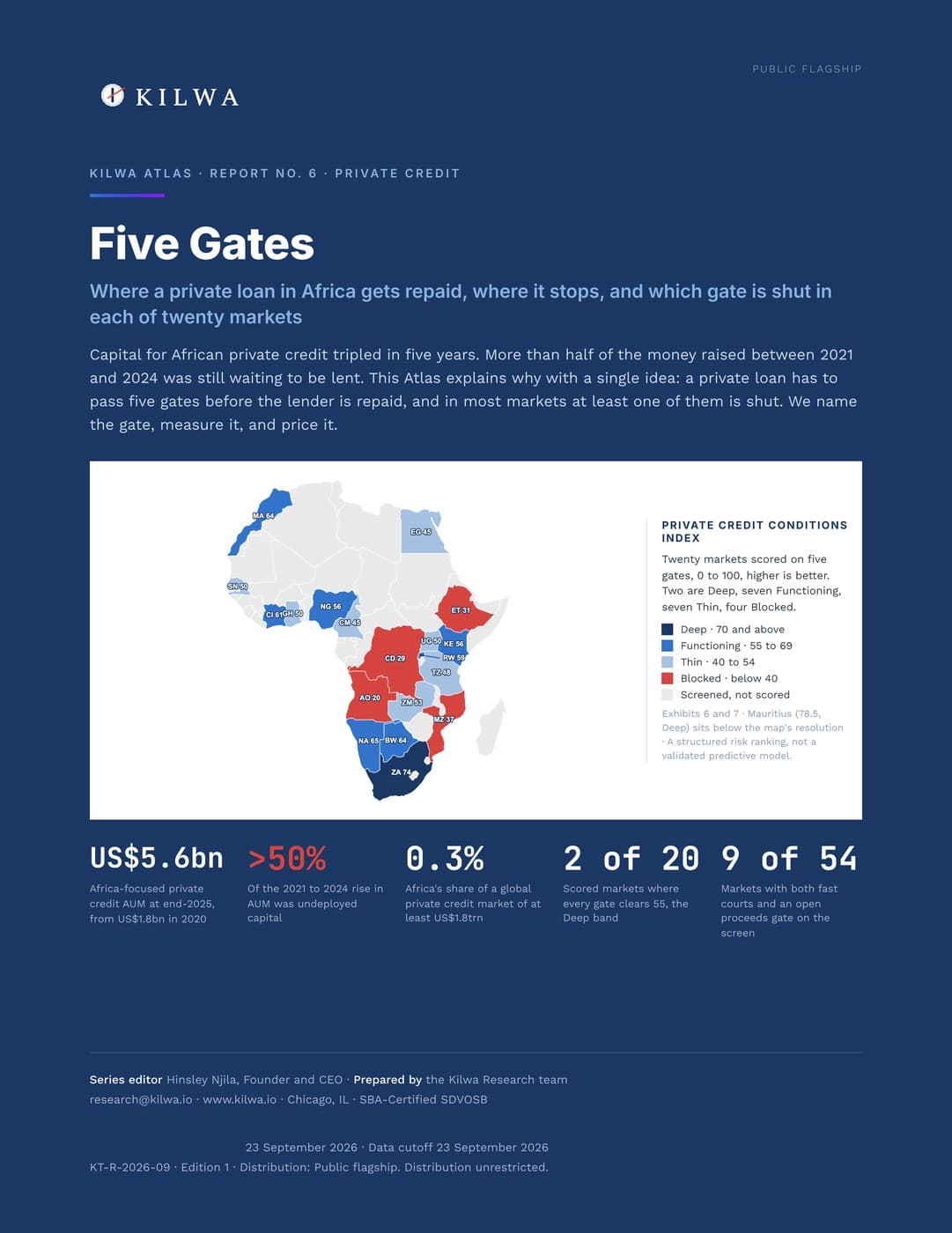
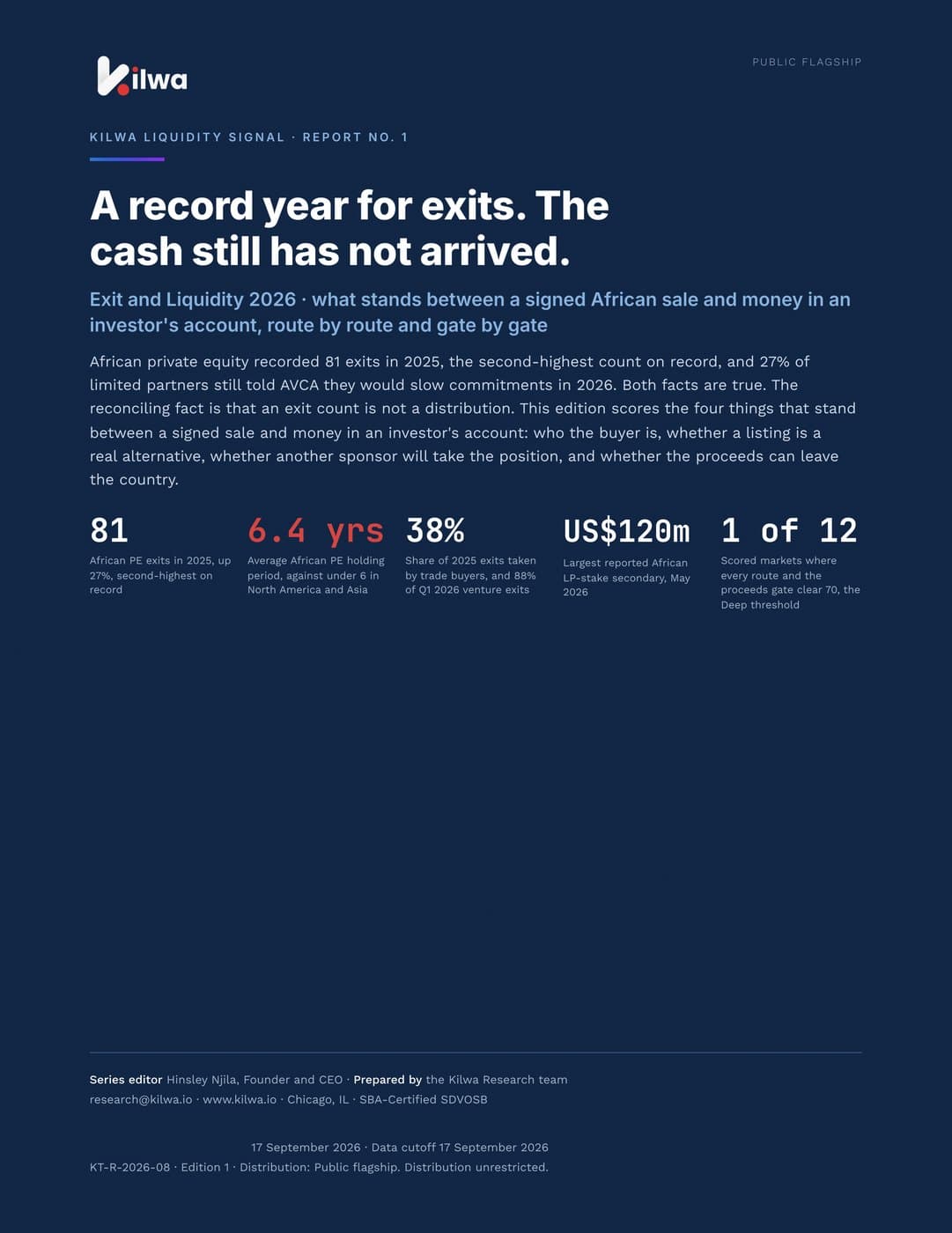
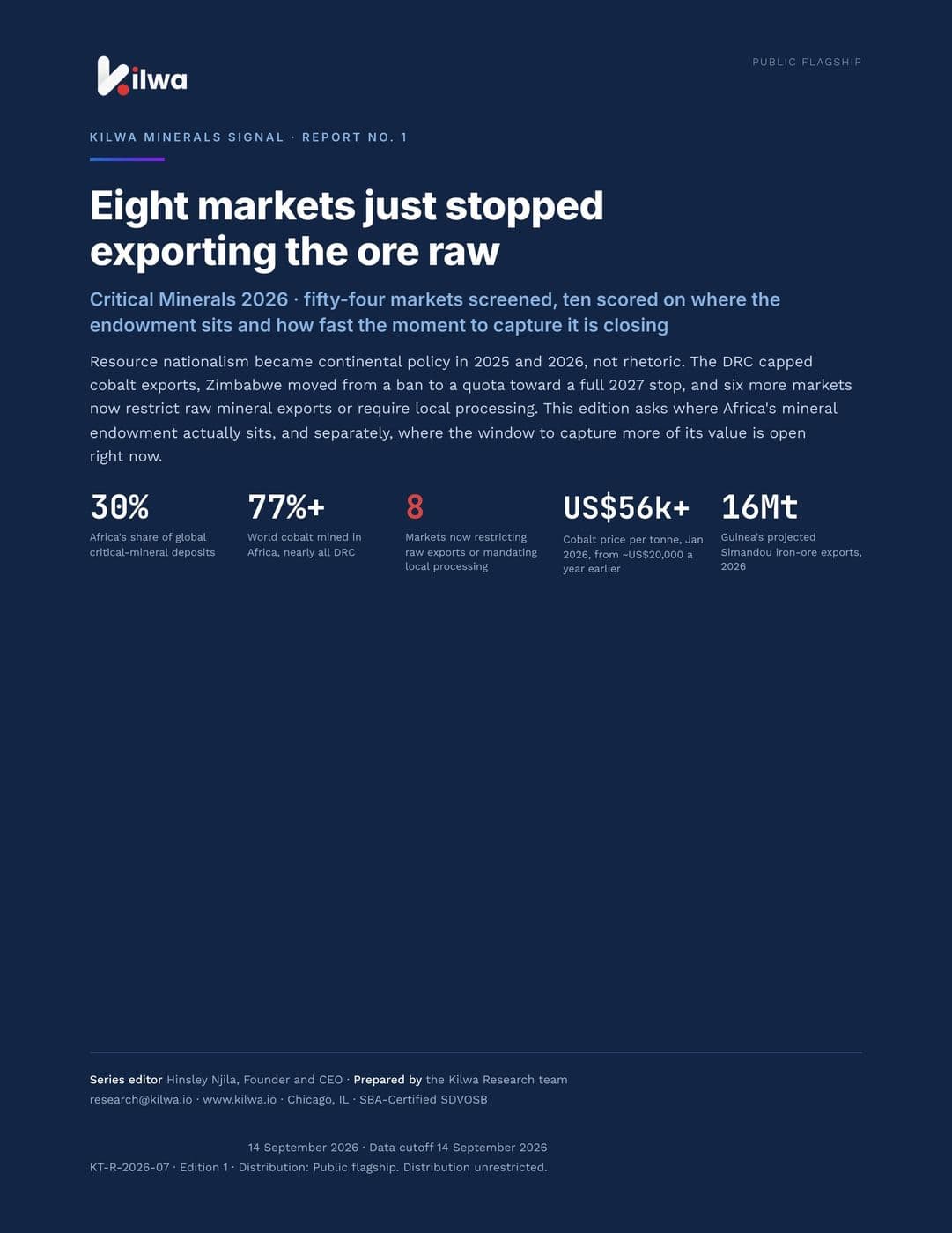
Nineteen flagships. One scored continent.
Growth, tail risk, currency, exits, resource nationalism, regulation, AI infrastructure and energy, scored across all 54 African markets — every input provenance-flagged, every model published, and every pre-registered call in Africa Signal Check graded in public, misses included.
Flagship reports are sold individually from $1,500, with team and enterprise licences available. Regional briefs and Africa Signal Check are published open.
The Kilwa Intelligence Platform
Six modules. One decision.
Every module feeds the same answer. Nothing here is a separate dashboard you have to reconcile.
Investment Suitability Index
A dynamic scoring engine that ingests structured economic data — GDP, FDI flows, inflation, governance and regulatory indicators — to generate a live investment readiness score for any country and sector.
Learn more 02Market Entry Timing Index
A predictive forecasting engine that fuses time-series analysis with NLP-driven sentiment tracking from news and policy statements to identify optimal entry windows.
Learn more 03Multilingual Sentiment Pulse
Trained on region-specific media to analyse risk, tone, policy shifts and leadership signals in French, Arabic and Swahili — capturing local context that English-only platforms miss entirely.
Learn more 04Zawadi AI
Ask a question in plain English and get an answer about the market — grounded in the same signals, with the same decomposition, as every score on the platform.
Learn more 05Explainable AI
Every score comes with an explanation. SHAP-based attribution and published model cards show exactly which factors drive a result — the transparency institutional risk committees require before capital moves.
Learn moreAsk anything
“Which of the 54 markets carry unhedgeable currency exposure, and why?”
Zawadi answers in plain language from Kilwa’s published scores, and every figure traces back to the input that produced it.
Meet ZawadiBuilt for
Different mandates. The same two questions.
Kilwa serves the institutions allocating capital into frontier markets — and the governments building the capability to attract it.


Sovereign Wealth Funds
Diversification intelligence that identifies high-potential markets beyond the traditional safe havens.
Multinational Corporations
Data-driven market expansion strategy that replaces analyst gut-feel with scored, explainable intelligence.
Governments & Public Institutions
The evidence layer a finance ministry, debt office or investment promotion agency needs to be read accurately by the market — and sovereign AI built to be owned locally.

Kilwa Sovereign AI
National-scale AI, built to be owned locally.
Our government vertical delivers sovereign AI capability — including language model work in national languages — built with the institutions that will own and operate it. Systems delivered without local capacity become dependencies, and dependencies expire.
Trust & transparency
Every score shows its workings.
We describe our scores as structured risk rankings, not validated predictive models, wherever that is the honest characterisation. Model cards document scope, training data, known weaknesses and what would invalidate the result.
1,000
draw Monte Carlo robustness tests published per flagship score
100%
of model inputs flagged verified or estimate
AES-256
encryption in transit and at rest
SOC 2
Type II controls, aligned

Request a demo
See the markets you follow, scored.
We'll walk your team through ISI and METI across our covered markets — and show you the decomposition behind every score.